

Dutch Ship and “Dutch” Medicine – Nakajima Yusuke, 1842
€1.650
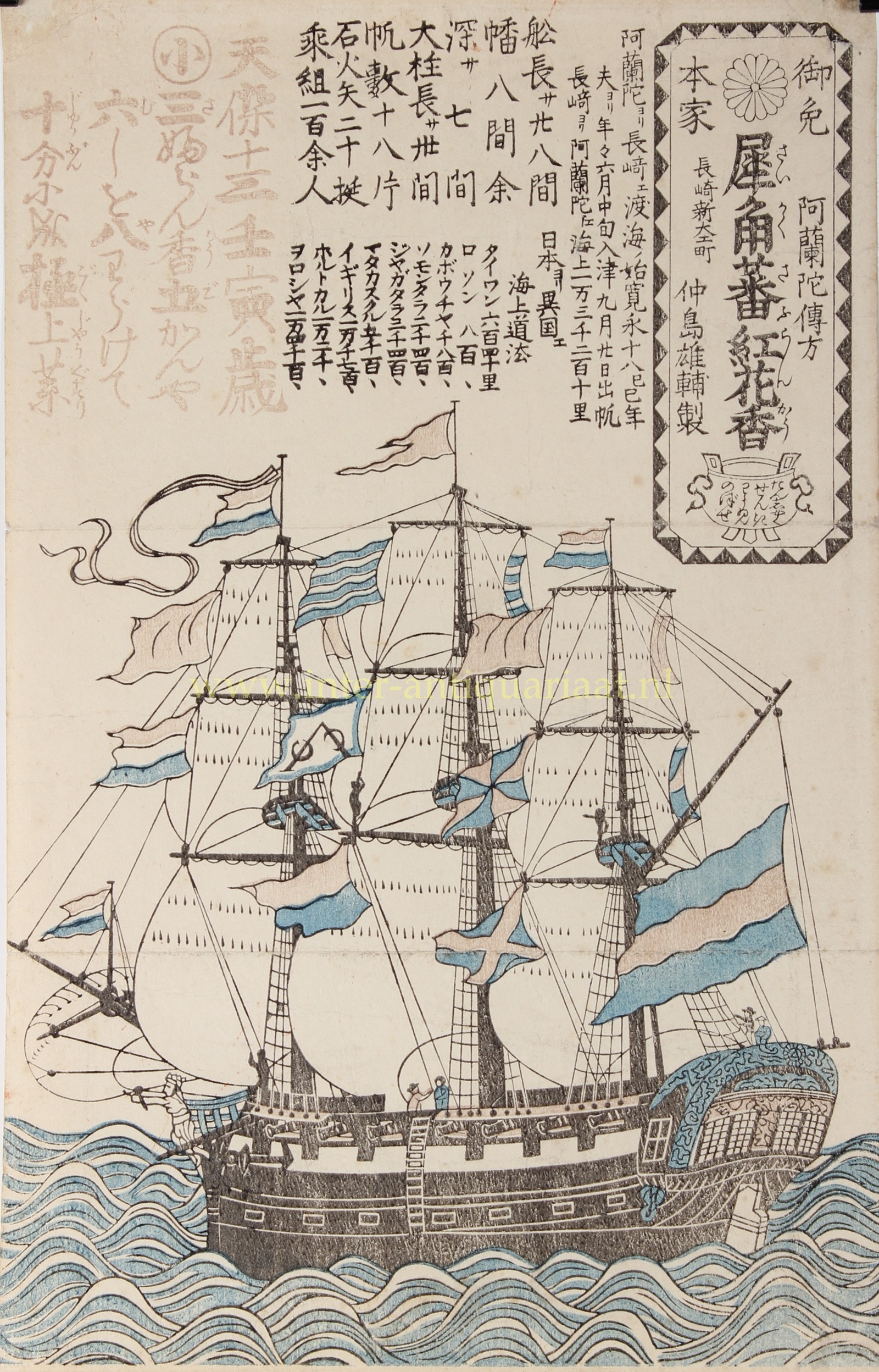
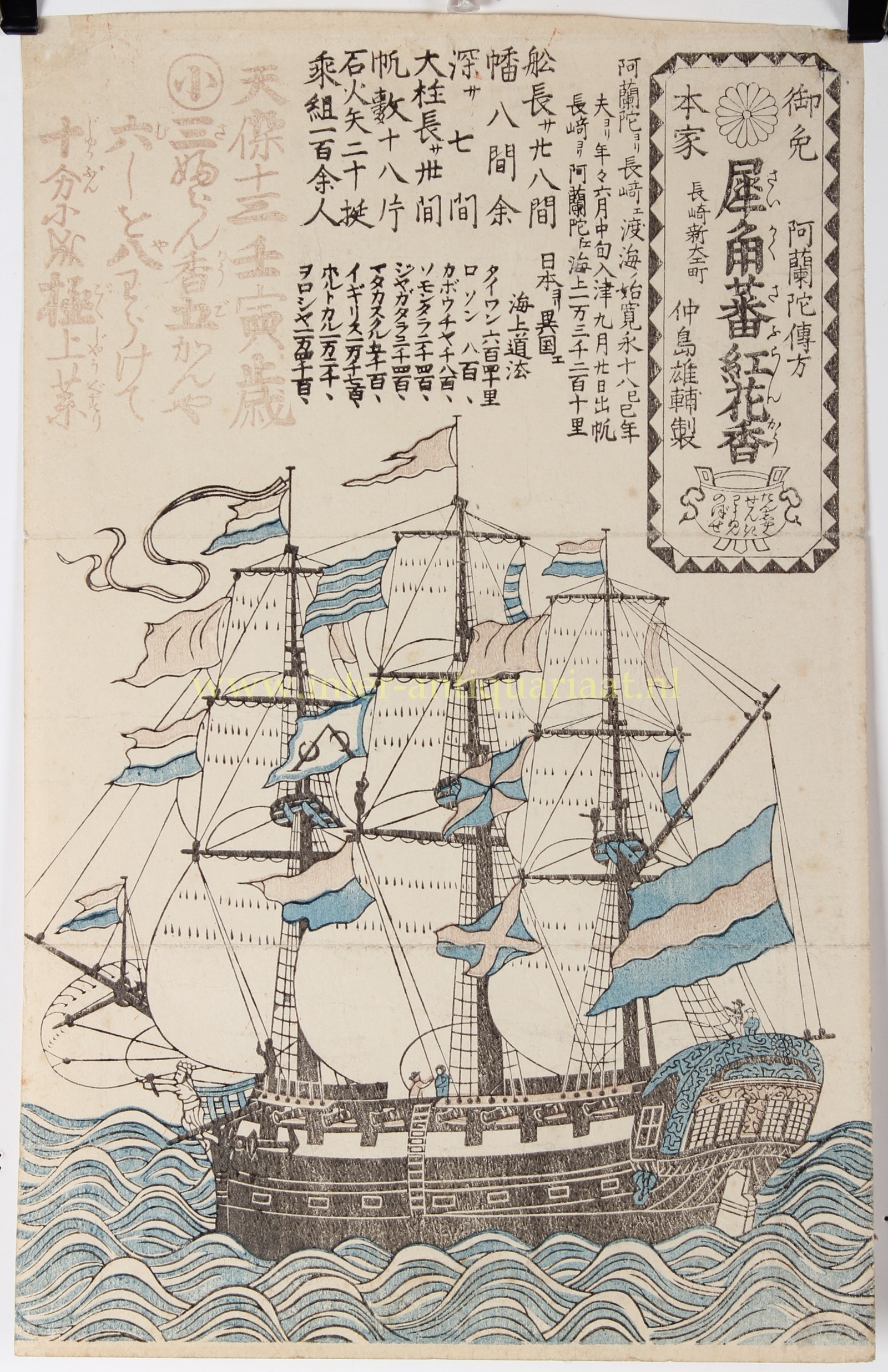
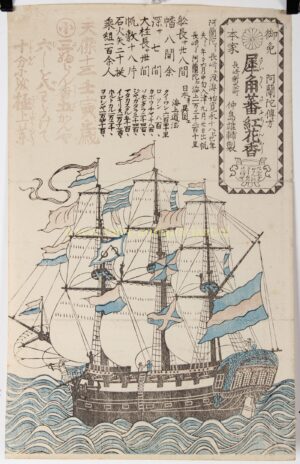
DUTCH SHIP IN NAGASAKI, ADVERTISING A “DUTCH” MEDICINE
“阿蘭陀傳方 犀角蕃紅花香” [Oranda denpō saikaku safurankō / Dutch transmitted recipe: rhinoceros-horn and saffron aromatic]. Japanese woodblock print, Nagasaki-e, made in Nagasaki by Nakajima Yūsuke in 1842 (“Tenpō 13”). Size (paper): 29 x 18.2 cm.
This rare Nagasaki-e shows a large Dutch sailing ship on a turbulent sea. The vessel is depicted as an imposing, almost exotic object: fully rigged, with several masts, numerous sails, flags, and a number of crew members on deck and in the rigging. The blue-and-white flag with a monogram-like device appears to refer back to the VOC emblem. However, the print dates from long after the disappearance of the Dutch East India Company. It should therefore probably not be read as contemporary flag usage, but as a pictorial formula derived from earlier Nagasaki prints. The image is thus not intended as an accurate record, but as a Japanese imagining of the “Dutch ship” as a symbol of distant trade, foreign technology, and exotic goods.
Above the image are several blocks of text. The central block gives pseudo-encyclopaedic information about the ship: a length of 98 ken [1 ken = 1.82 metres], a width of more than 8 ken, a depth of 7 ken, a mainmast of 30 ken, eighteen sails, thirty cannon, and a crew of more than two hundred men. It also states that, since Kan’ei 18 [1641], the Dutch had arrived in Nagasaki every year around the middle of the sixth month and departed again on the twentieth day of the ninth month. The text also gives the sea distance from Nagasaki to Holland as 13,310 ri (more than 50,000 kilometres when converted!!) and lists routes or distances from Japan to, among other places, Taiwan, Luzon, Cambodia, Sumatra, Batavia, Madagascar, England, Portugal, and Russia.
Remarkably, the print does not merely depict a ship; it also advertises a medicine. At upper right appears the title “阿蘭陀傳方 犀角蕃紅花香”, which may be translated as “Dutch transmitted recipe: rhinoceros-horn and saffron aromatic.” The mention of 御免 suggests that the product was promoted as permitted or authorised. The Dutch ship therefore functions as a visual endorsement: it connects the product with the distant, mysterious world of the Dutch and with the medical knowledge that entered Japan through Nagasaki.
Nagasaki occupied an exceptional position during the Edo period. While Japan strictly limited its foreign contacts, Nagasaki remained the official gateway for trade with China and, through Dejima, with Europe. From 1641 to 1859 Dejima served as the Dutch trading post and as a controlled channel for Western knowledge, medicines, instruments, and books.
The print belongs to the genre of Nagasaki-e: popular woodblock prints made in Nagasaki, showing foreigners, Chinese and Dutch ships, exotic animals, unfamiliar objects, and other subjects associated with the outside world in the eyes of the Japanese public. They were often sold as souvenirs to travellers, merchants, and scholars, but were also bought by Japanese customers who themselves had little direct access to information about foreign countries.
Price: Euro 1.650,- (incl. frame)