

West Indiaman – after Wenceslaus Hollar, 2nd half 17th century
€375
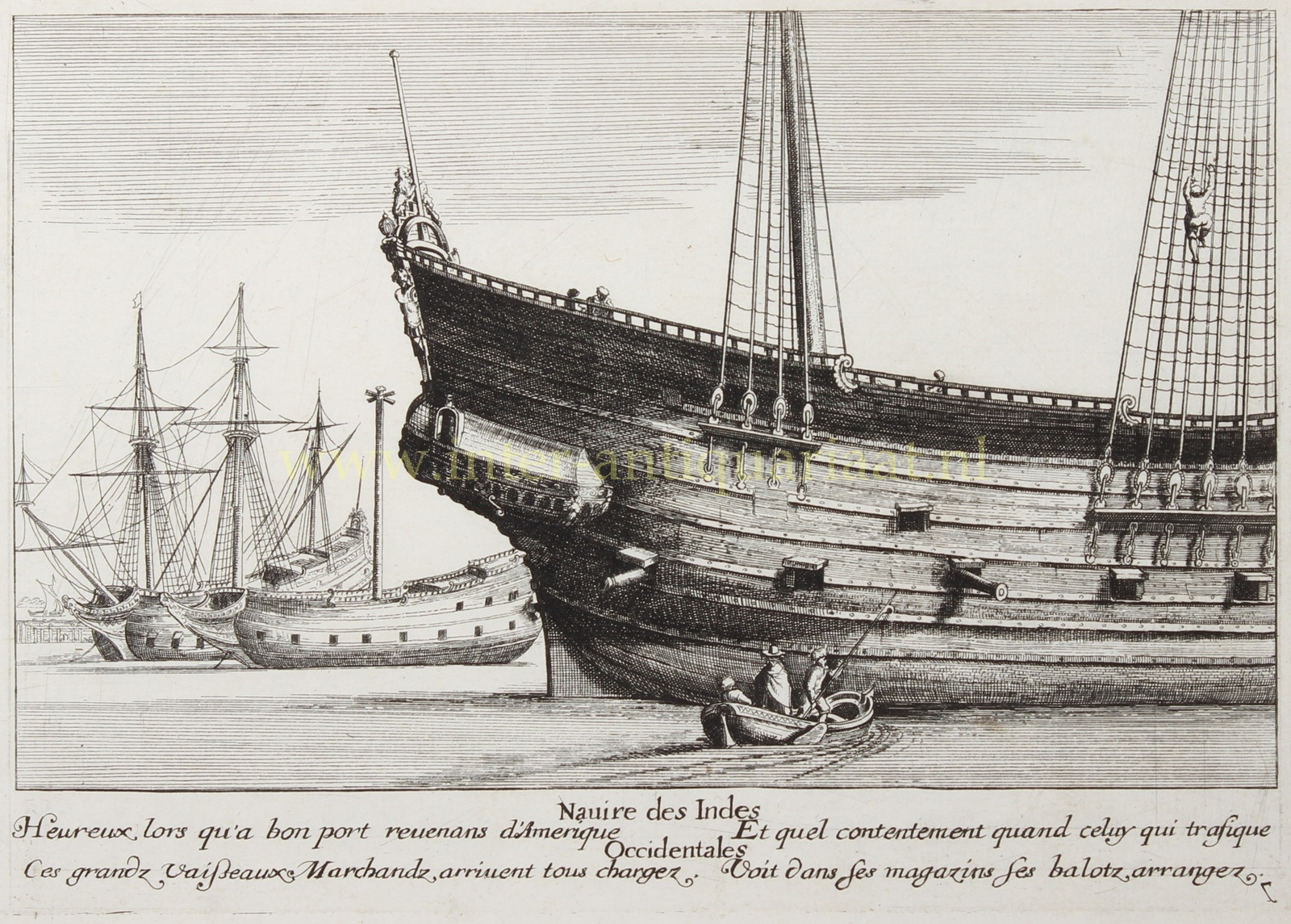
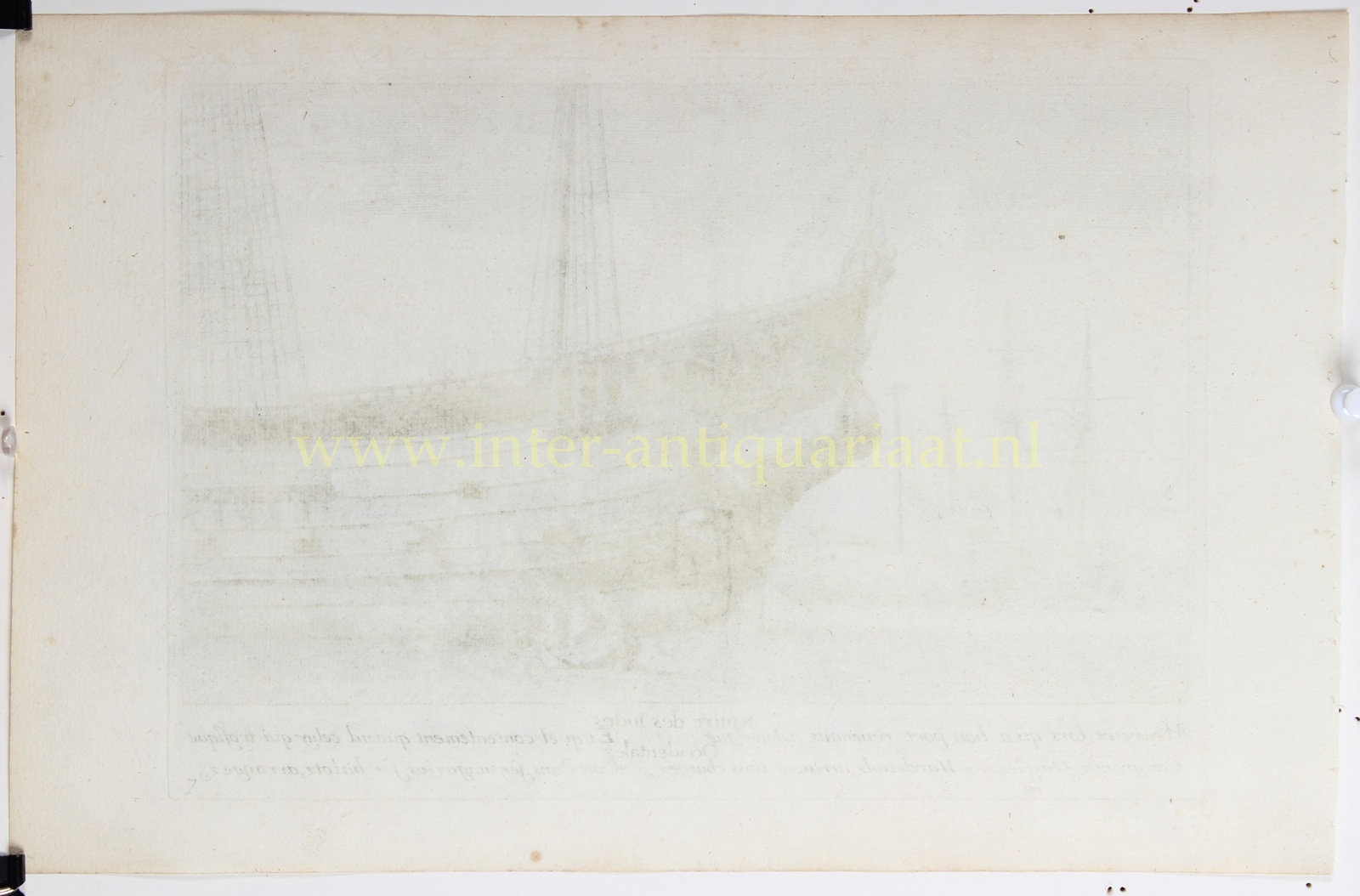


“Navire des Indes Occidentales”. Etching, published by Louis Boissevin. Seventeenth-century reversed copy after a print by Wenceslaus Hollar from 1647, made as part of the twelve-part series “Navium Variae Figurae.” Size: plate mark17.8 × 23.5 cm; paper 19.2 × 30.2 cm.
In comparison with Hollar’s etching, this example has a four-line descriptive text beneath the image:
“Heureux, lors qu’à bon port revenans d’Amerique
Ces grandz vaisseaux Marchandz, arrivent tous chargez,
Et quel contentement quand celuy qui trafique
Voit dans ses magazins ses balotz arrangez.”
these great merchant vessels all arrive fully laden;
and what satisfaction for the man engaged in trade,
when he sees his bales arranged in his warehouses.]
The image shows an imposing merchant ship of the West Indian trade, prominently depicted in the foreground. The high stern, richly worked sterncastle, gunports and heavy rigging emphasise the size and seaworthiness of the vessel. On the left, in the background, other sailing ships lie moored, while in the foreground a small rowing boat comes alongside. The contrast between the large sea-going vessel and the small boat underlines the scale of these ocean-going ships.
The title “Navire des Indes Occidentales” refers to the West Indian trade: the transatlantic commerce with America and the Caribbean. In the seventeenth century, ships of this kind were indispensable for the supply of colonial commodities to European ports. The French text beneath the print relates directly to this theme. The emphasis is not on the adventure of the sea voyage, but on the fortunate moment of return: the ship arrives safely and fully laden in port, bringing profit and satisfaction to the city.
Wenceslaus Hollar (1607–1677) was a Bohemian artist, trained in Prague, who, after several journeys through the German territories and the Netherlands, arrived in England in the 1630s. In the following decade, however, he fled the civil wars taking place there and returned to the Low Countries, more specifically to Antwerp.
Hollar’s travels and his stay in the Netherlands left a clear mark on the prints he produced. In 1647, in Antwerp, he published his celebrated Navium Variae Figurae et Formae. This series consisted of twelve prints showing various Dutch vessel types in detail and is characteristic of Hollar’s great fascination with the sea and shipping. The present image also formed part of the series. Typical of the images in this work is the eye-level viewpoint. As a result, these prints have a low horizon, which in turn allows for a large expanse of sky.
Price: Euro 375,-