

Thés Palais Indiens – Georges de Feure, 1894
€275
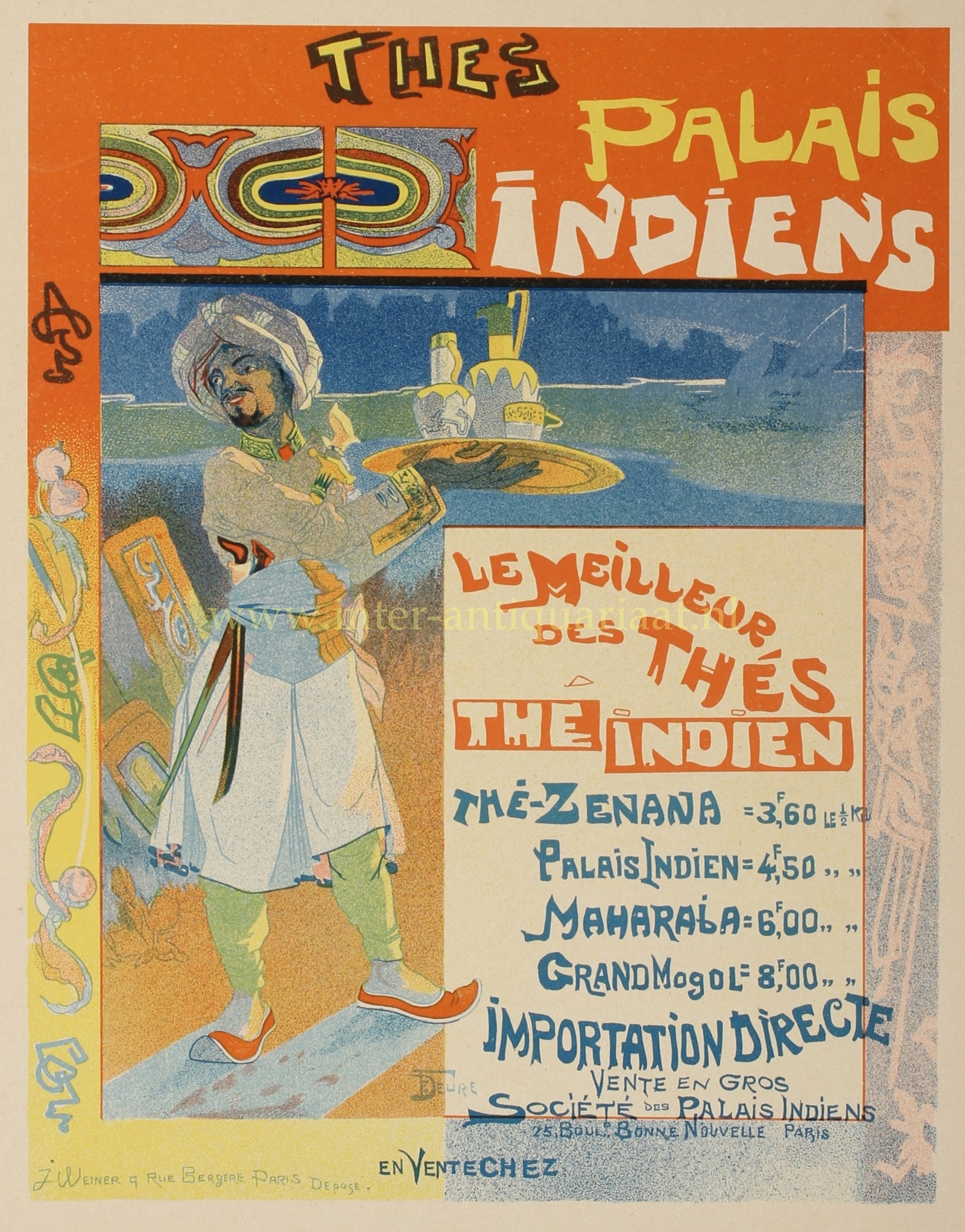
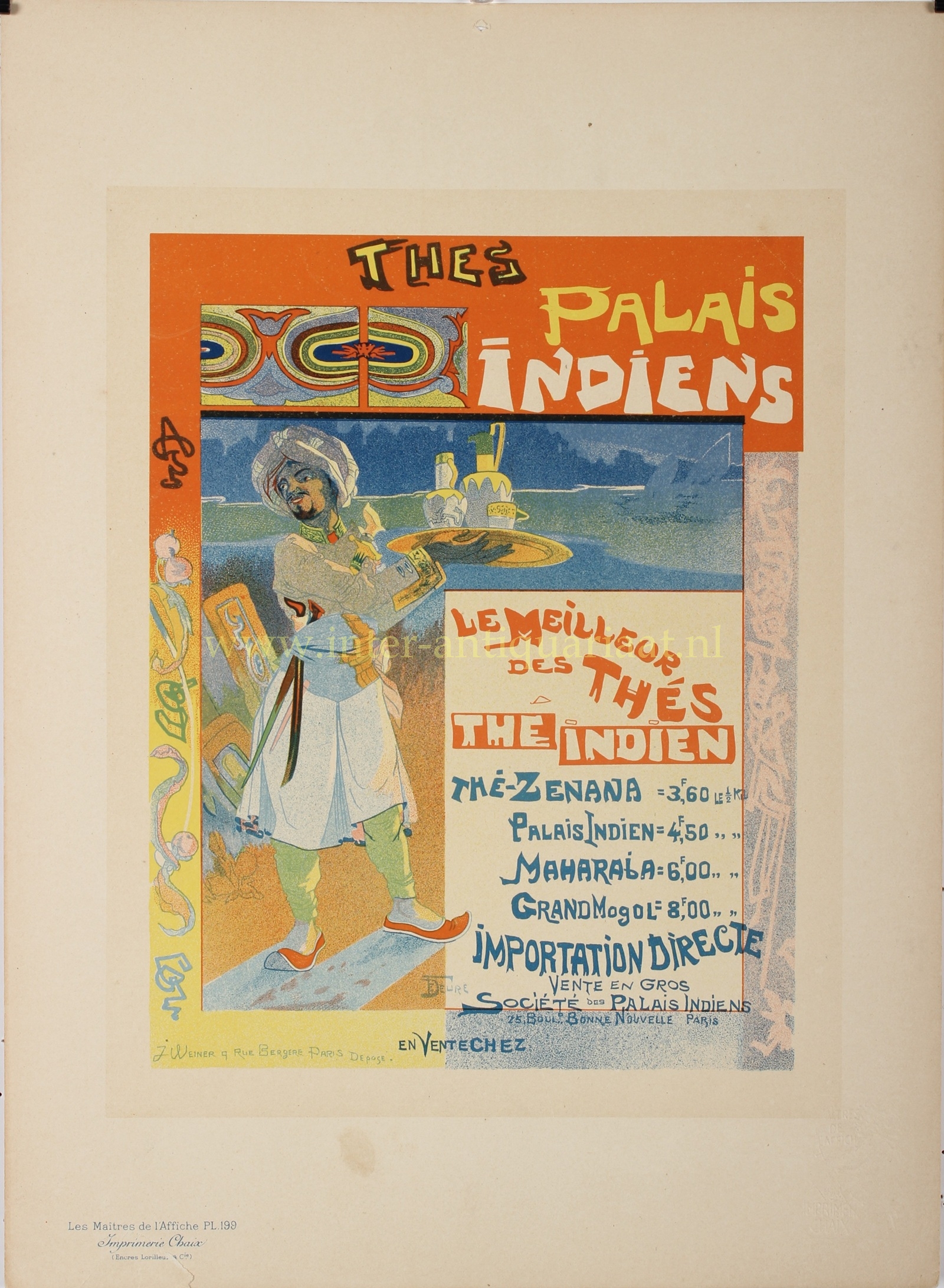
GEORGES DE FEURE – ART NOUVEAU ADVERTISEMENT FOR INDIAN TEA, 1894/1900
“Thés Palais Indiens”, Art Nouveau poster by Georges de Feure, colour lithograph designed in 1894 for the Société des Palais Indiens in Paris. This reduced-format version was published by Imprimerie Chaix in Paris in 1900 as part of the celebrated series Les Maîtres de l’Affiche. With the embossed stamp Les Maîtres de l’Affiche – Imprimerie Chaix at lower right. Sheet size approx. 40 × 29 cm; image: 23.6 × 28.5 cm.
De Feure transformed a relatively everyday product such as tea into an emphatically exotic luxury commodity. The poster employs a Western image of the Orient characteristic of the fin de siècle: the turbaned attendant, fanciful ornamentation and names such as Maharadja and Grand Mogol were intended to suggest authenticity, distant origins and exclusivity. At the same time, the design was strikingly modern for its period. Large areas of flat colour, bold outlines, an asymmetrical composition and playfully drawn lettering occupy almost the entire poster.
Georges de Feure (1868–1943), born in Paris as Georges Joseph van Sluijters, was of Dutch descent and worked for several years in Amsterdam before returning to Paris in 1890. There he established himself as a painter, illustrator, poster artist and designer. His posters attracted the attention of art dealer Siegfried Bing, for whose famous Maison de l’Art Nouveau he later designed furniture, ceramics, glassware and complete interiors. De Feure thus became one of the most versatile designers of French Art Nouveau.
Les Maîtres de l’Affiche was published between 1895 and 1900 by Imprimerie Chaix under the direction of Jules Chéret. Subscribers received four reduced-format lithographic versions of important contemporary posters each month. The series thus provided a survey of the flourishing of European poster art and included designs by Toulouse-Lautrec, Mucha, Steinlen, Chéret and De Feure, among others. Thés Palais Indiens appeared as plate 199 in issue 50, in January 1900.
Price: Euro 275,-