
German WWI propaganda – Leutert & Schneidewind, 1914
€575


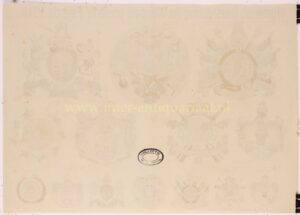
GERMAN PROPAGANDA SATIRE ON THE ALLIES, 1914
“Humorist. Darstellung der Wappen unserer Feinde 1914.” Colour lithograph, printed and published by Leutert & Schneidewind in 1914. Size: (approx.) 34.6 × 49.3 cm.
Early German war satire from the first months of the First World War, in which the coats of arms of France, Russia, England, Montenegro, Belgium, Serbia and Japan have been transformed into cartoons. Along the lower edge the actual national emblems are printed for comparison: not merely as an aid to recognition, but above all to throw the grotesque distortion above them into sharper relief.
The opponents of the German Empire are portrayed as cowardly, corrupt, dependent, mendacious, or weakened by internal divisions. Like much visual propaganda of 1914, the sheet reduces entire countries and peoples to national clichés, political enemy-images and racist stereotypes.
The print must have been designed shortly after the outbreak of war. The references to Field Marshal Hindenburg and “Masurien” connect to the German victories over the Russians at Tannenberg and the Masurian Lakes in August and September 1914, after which Hindenburg at once rose to become a German war hero. The “42 cm Brummer” beside Belgium refers to the heavy German siege mortars, known as “Dicke Bertha” or “Big Bertha”, deployed in August 1914 against the Belgian forts around Liège and Namur.
France
The monogram “R.F.” [République française] is read as “Revanche futsch!” [the revenge is lost]. With this the print mocks the French wish to recover Alsace-Lorraine, which had been part of the German Empire since 1871. The motto Liberté, Égalité, Fraternité is broken down into “francs-tireurs,” dum-dum bullets, “two loudmouths,” and a march to the prisoner-of-war camp. The figures allude to German accusations of irregular combatants and prohibited ammunition, but also to French colonial troops.
Russia
The Russian double-headed eagle is filled with a caricature of Tsar Nicholas II. The shield on its breast bears not Saint George but “Masuria,” with Hindenburg as victor. Around it appear small shields inscribed with, among other things, “Wutki” [a blend of “Wut“/rage and vodka], lice, burial mounds labelled “Freiheit” [freedom], roubles, knouts, and a chained Russian bear.
England
The arms depict a capitalist, hypocritical world power. The official motto Dieu et mon droit is replaced by “Alles für den Geldsack” [everything for the money-bag]. The garter encircling the shield reads: “Lass Andre immer siegen. Wir lügen!” [Let others always win. We lie]. The English lion is throttled by a serpent inscribed “Indien” [India], while money-bags, a donkey in place of the unicorn, and a Zeppelin marked “Made in Germany” ridicule the British Empire, its colonial tensions, and its dependence on trade.
Montenegro
King Nikola I is shown surrounded by large quantities of money. The bags marked “1000 Rubel” and “10,000 Rubel” are held out by Tsar Nicholas and allude to Montenegro’s financial dependence on Russia.
Belgium
The Belgian arms are perhaps the sharpest propagandistic distortion of all. The Belgian lion is chained and fitted with a kind of muzzle, leans on a crutch, and has one paw in a bandage. The motto “L’Union fait la force” has been altered to “42 cm Brummer fait la force“: it was not Belgian unity but the German heavy mortar that is said to have conquered Belgium. The texts “Schütz mich vor meinen Freunden” [protect me from my friends] and “Englands Freundschaft war mein Fall!” [England’s friendship was my downfall] lay the blame for Belgium’s fate on England. This is a propagandistic inversion of reality: Belgium was neutral and was invaded by Germany in August 1914, and it was precisely that violation of neutrality that helped bring Britain into the war.
Serbia
In the Serbian arms stands King Peter I, above him two skulls beneath the names “Draga – Alexand[er].” These refer to King Alexander Obrenović and Queen Draga, who were murdered in a military coup in 1903. The text “Hilf Nicolaus, sonst ist es aus!” [help, Nicholas, or it is all over] casts Serbia as wholly dependent on Tsar Nicholas II of Russia. “Wär’ ich schon ‘raus” [if only I were already out of it] puts a fearful, defeatist remark into the mouth of King Peter I. Beneath the king, caged within the crown, we see the coffin of Archduke Franz Ferdinand of Austria, assassinated at Sarajevo, the event with which the First World War began.
Japan
Japan is represented by the imperial chrysanthemum emblem, encircled by a ring of uniformed apes holding one another by the tail. Japan is shown because it entered the war against Germany in August 1914, followed by the struggle for the German base of Tsingtao in China.
The publisher presents the sheet as a “Kriegsandenken und Kuriositäten-Sammler“, a souvenir for collectors of war memorabilia and curiosities.
Price: Euro 575,-