

Arsenal – Georg Balthasar Probst, c. 1750
€375
18TH-CENTURY ARSENAL
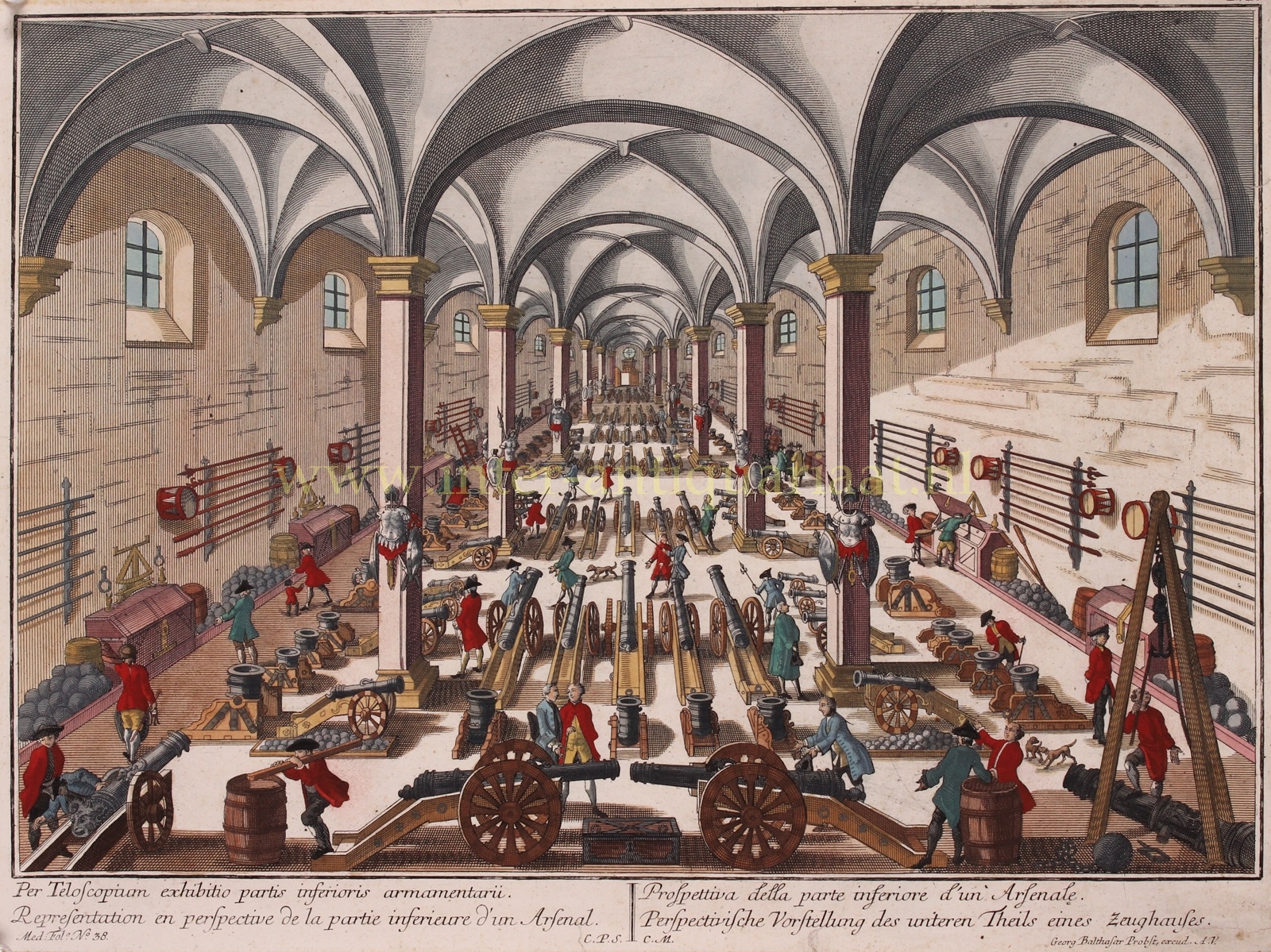
“Per telecopium exhibitio partis inferioris armamentarii. / Representation en perspective de la partie inferieure d’un arsenal.” Engraving made by Georg Balthasar Probst, ca. 1750. Original hand-colouring with later additions. Size: 28.3 × 41.2 cm.
An arsenal in the 17th and 18th centuries was a vast depot for weapons and ammunition, where artillery, firearms, cannonballs, powder barrels and other military equipment were manufactured, maintained and stored. Such buildings not only supplied armies and garrisons, but also served as powerful symbols of military strength and civic organization.
The print shows an imposing vaulted hall filled with cannons, gun carriages, mortars, piles of iron cannonballs, and barrels of gunpowder. Spears and drums hang neatly along the walls. Workmen and soldiers are engaged in inspecting and cleaning the artillery. The orderly arrangement and sheer abundance of equipment emphasize both the might of the military and the efficiency of its organization.
The engraving was published by Georg Balthasar Probst in Augsburg, which by the mid-18th century had become the leading centre for the production of perspective views or vues d’optique. These prints—often city views, interiors, or exotic scenes—were designed with strong perspective and bright colouring to be viewed through a zograscope (optical viewer). The magnification and enhanced depth created an almost three-dimensional illusion of space. Probst was one of the most prolific publishers in this genre, supplying a pan-European market that stretched from Paris and London to Amsterdam.
Price: Euro 375,-