

Atlas title page – Johannes de Ram / Jacob Harrewijn, 1685
€750

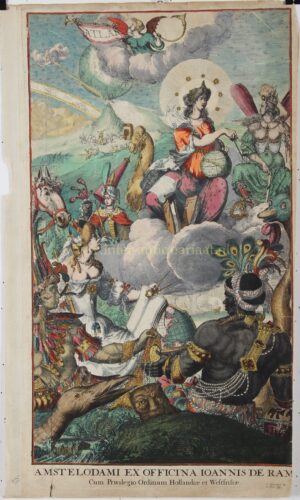
GEOGRAPHY, NAVIGATION AND THE WORLD – TITLE PAGE OF JOHANNES DE RAM’S ATLAS, 1685
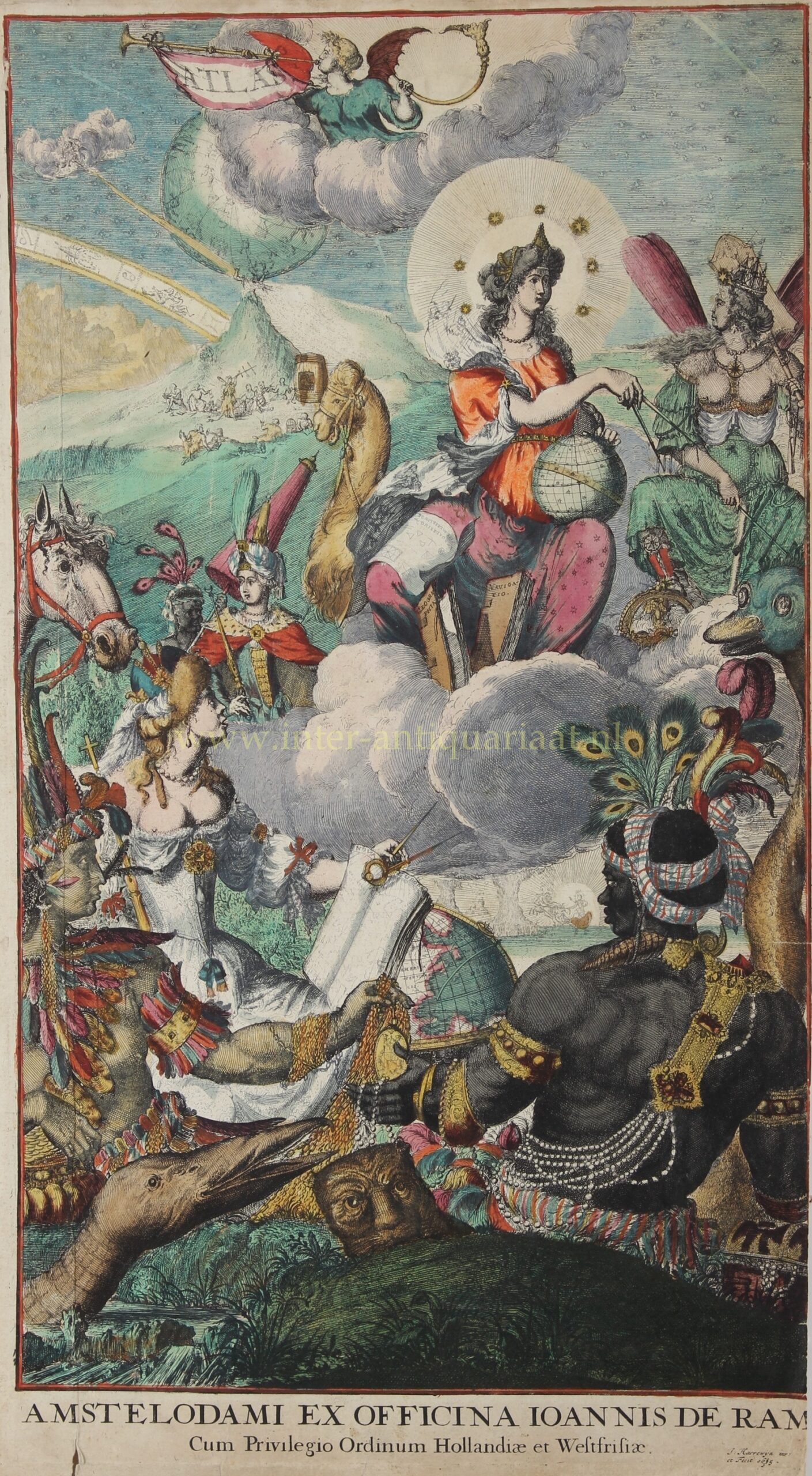
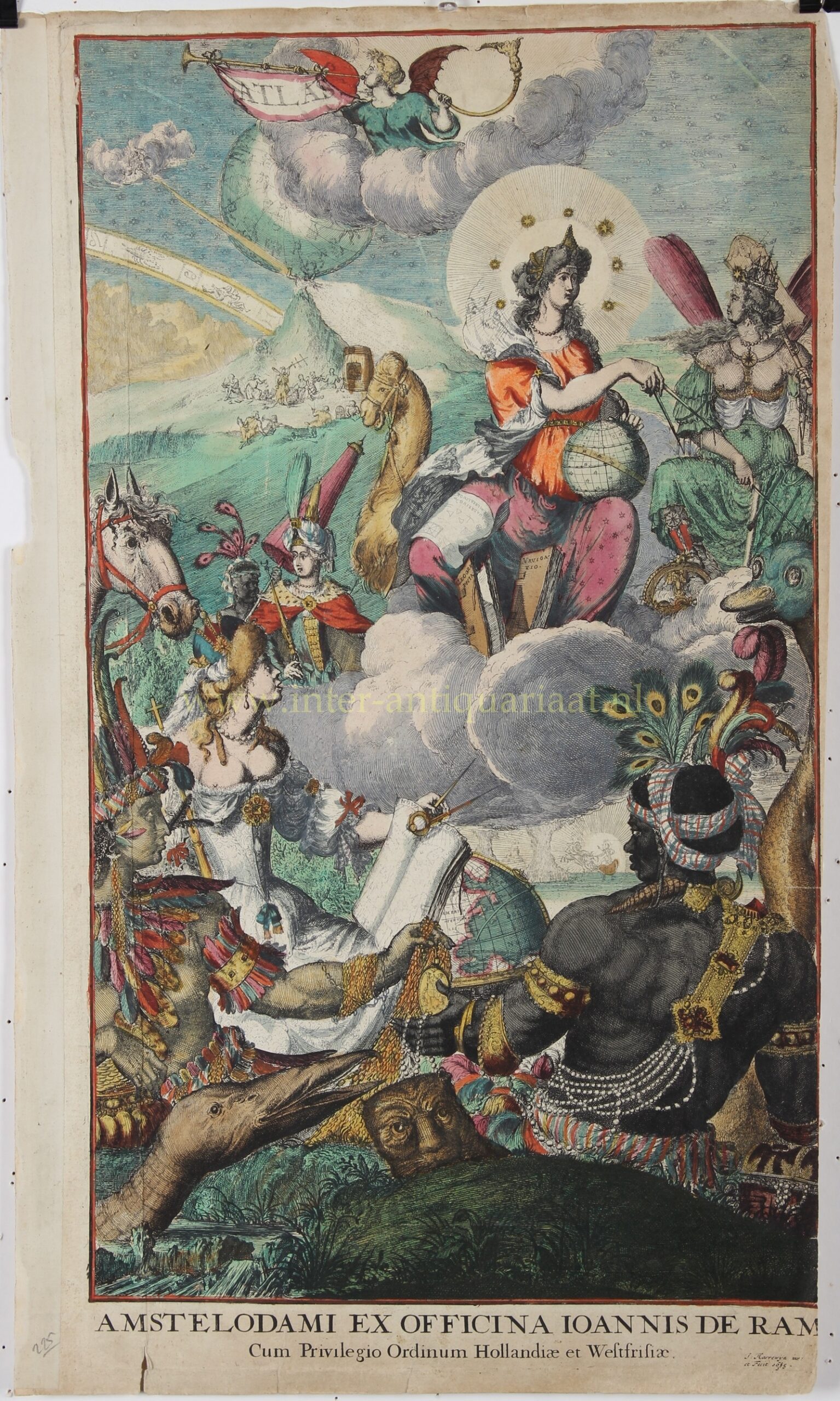
“Atlas”, title page for the atlas of Johannes de Ram, made by Jacob Harrewijn in 1685. Signed at lower right “J. Harrewyn 1685”. Etching and engraving, with orignal hand colouring. Approx. 49.5 × 29.5 cm (sheet).
Harrewijn filled the sheet with an exceptionally rich allegorical vision of the world. On the left stands a Native American wearing a feathered headdress and gold chains; on the right is an African man, lavishly adorned with feathers, jewellery and beads. Behind the Native American sits Europe, holding a compass and with an atlas open on her lap at the map “Nova Europa”. A horse, ostrich, camel and other exotic animals reinforce the references to the different parts of the world.
Higher in the composition, two female personifications occupy the centre. Geographia, personifying geography, sits upon a cloud surrounded by a halo of stars. She holds a compass and a celestial globe. Opposite her is a personification of navigation. She wears a three-masted ship as a crown and is equipped with an oar and a cross-staff; at her feet lie a compass and a rolled map. Books inscribed “Geographia” and “Navigatio” make their identities explicit.
Above them stretches the cosmos. The goddess Fama blows a trumpet from which flies a banner bearing the word “Atlas”. Behind the clouds appears a celestial globe carried by Atlas, while stars and the zodiac running diagonally across the heavens refer to astronomy. Smaller, almost hidden scenes likewise evoke science and discovery. Apollo drives away the darkness in his chariot of the sun; a group of scholars and geographers studies the world with the aid of instruments and a globe. The barrel containing a man also appears to refer to Willem Barentsz and his wintering on Novaya Zemlya.
Johannes de Ram (1648–1693) worked in Amsterdam as an engraver, map publisher, globe maker and art dealer. He sold many maps by other publishers, but also issued maps under his own name. For the composite atlases he assembled, he commissioned Harrewijn to produce this distinctive title print.
Jacob Harrewijn (ca. 1660–1727) was still at the beginning of his career in 1685. Born in Amsterdam, he worked there for various mapmakers and publishers before moving to Antwerp and subsequently Brussels. He later described himself as a pupil of Romeyn de Hooghe. De Hooghe’s influence can also be recognised in this title page: the composition is almost entirely filled with figures, animals, instruments and small narrative scenes.
Where many seventeenth-century atlas frontispieces were limited to Atlas, the four continents, or a few personifications of geography and navigation, Harrewijn brought together on a single sheet almost the entire traditional iconographic programme of the world atlas. It is precisely this abundance that makes the title page of De Ram’s rare atlas one of the most striking cartographic title prints produced in late seventeenth-century Amsterdam.
Price: Euro 750,-