

Sailing carriage by Simon Stevin for Prince Maurice – Joan Blaeu, 1649
€1.950
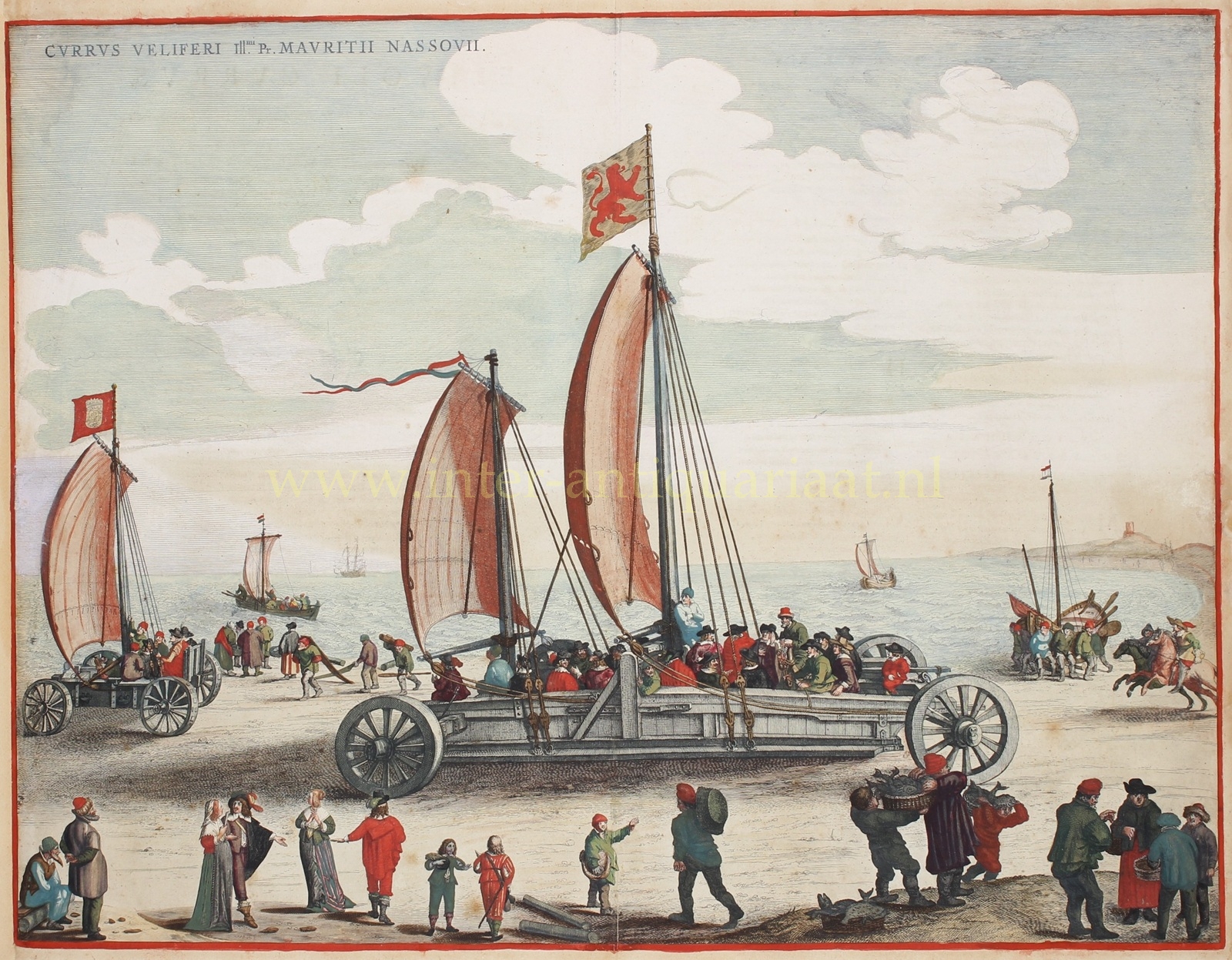
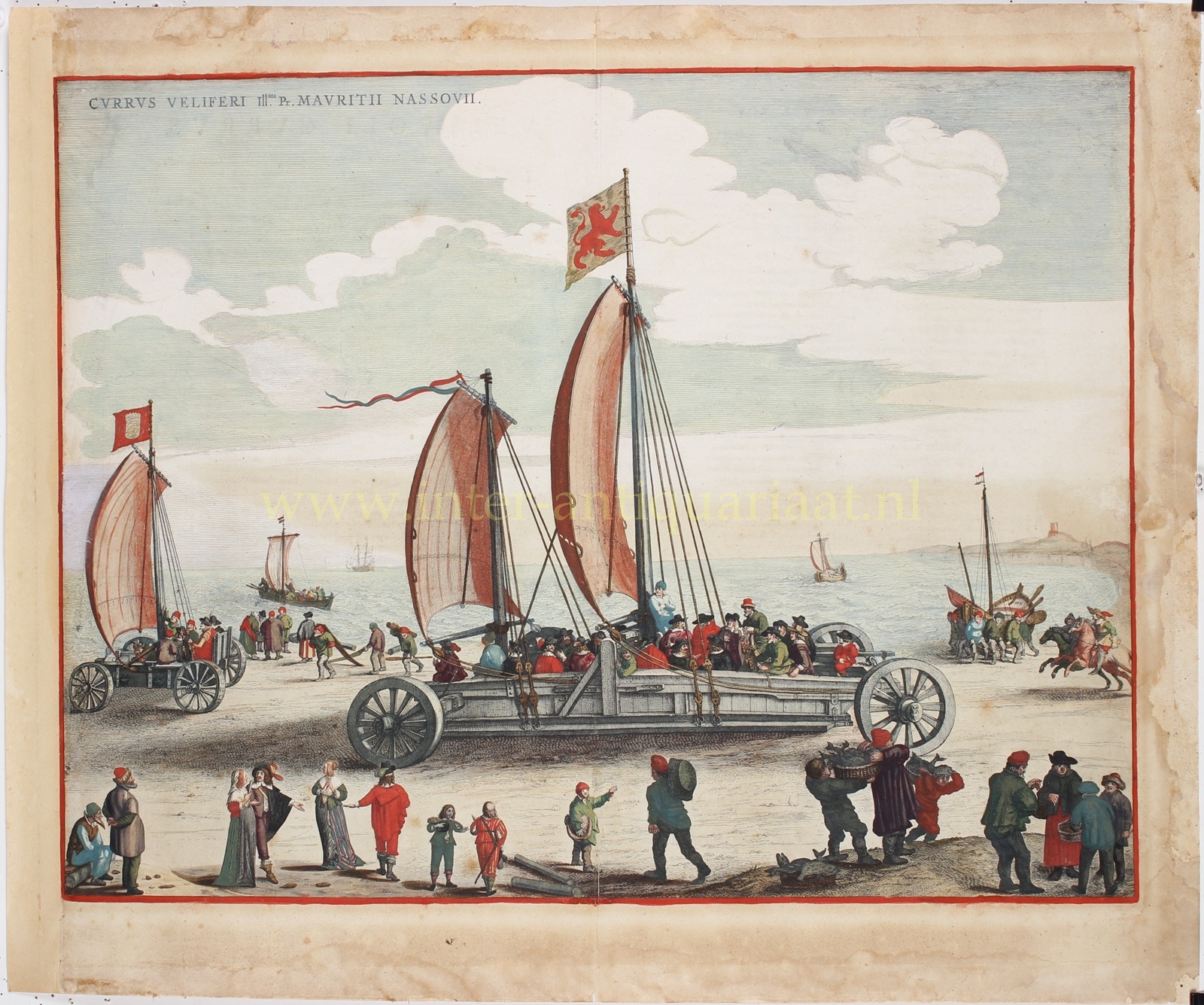


“Currus veliferi Illmi. Pr. Mauritii Nassovii.” [Sailing carriage of the Most Illustrious Prince Maurice of Nassau], etching and engraving published by Joan Blaeu in Amsterdam in 1649 as part of his Novum ac Magnum Theatrum Urbium Belgicae Liberae ac Foederatae, the first, Latin edition of his celebrated town book. With original hand colouring. Size (print): approx. 45 × 57 cm.
One day in the spring of 1602, Prince Maurice, accompanied by 27 guests, made a spectacular journey in his sailing carriage, also known as a ‘land yacht’, along the beach from Scheveningen to Petten. Designed by Simon Stevin, the vehicle was propelled entirely by the wind and flew the prince’s banner from its mast. Among the distinguished passengers were the nineteen-year-old Hugo Grotius, the French ambassador Paul Choart de Buzanval, Francisco de Mendoza, the Spanish commander captured at Nieuwpoort, Ulrik of Holstein, brother of the Danish king Christian IV, and Maurice’s half-brother Frederick Henry.
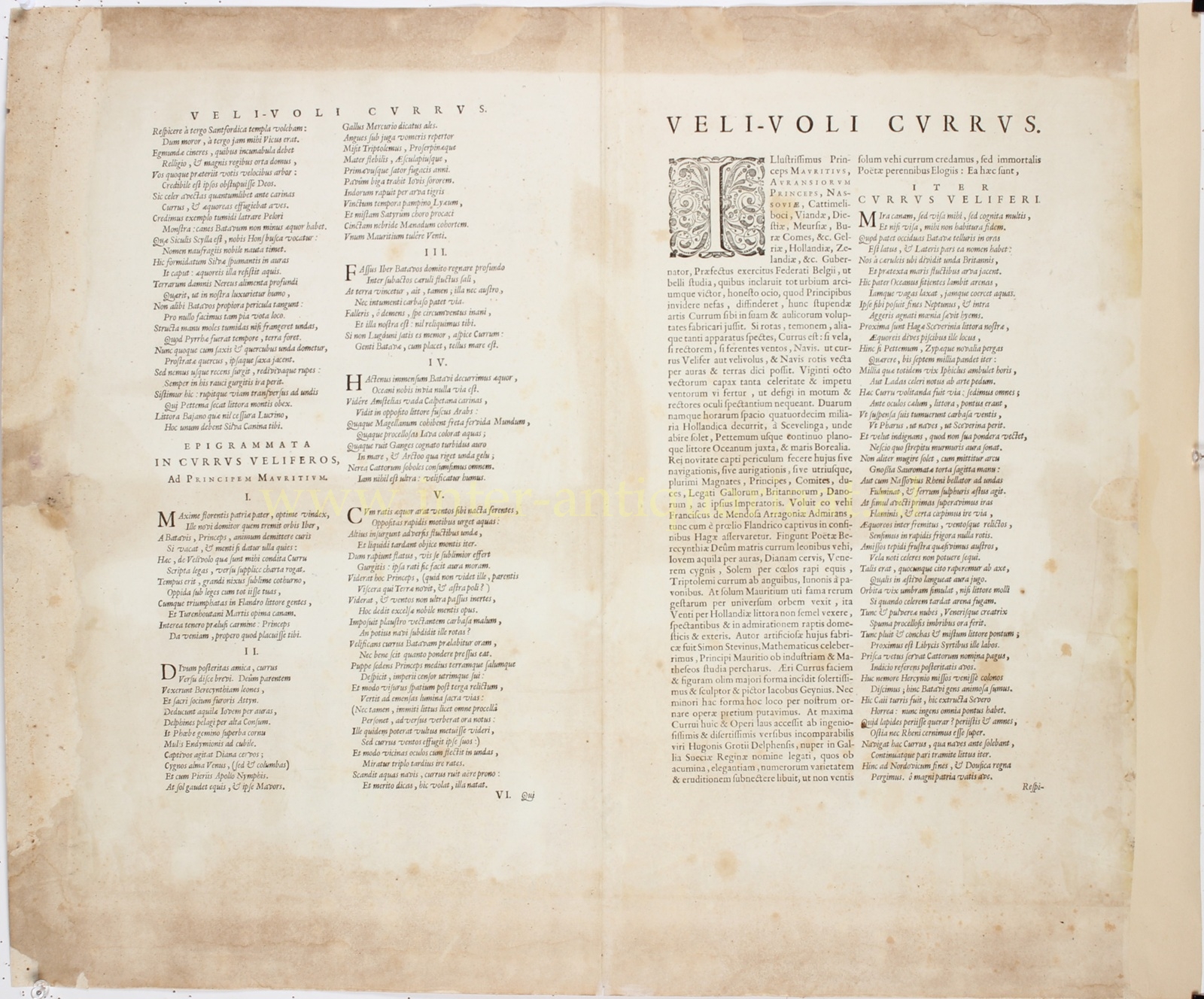
The Latin text printed by Blaeu on the reverse of the print presents the sailing carriage as a marvel of engineering. Looking at its wheels, pole and other equipment, one saw a carriage; looking at its sails, helmsman and the wind, one saw a ship. According to Blaeu, the vehicle covered the fourteen Dutch miles from Scheveningen to Petten in only two hours. It travelled along the continuous, level beach beside the North Sea, where no harbour mouths or other obstacles interrupted its course.
One of the passengers, Hugo Grotius, immortalised the journey in a poem that Blaeu also printed on the reverse. Grotius describes how Scheveningen disappeared from sight almost as soon as the wind filled the sails. The carriage left scarcely any wheel tracks in the sand, overtook ships and seabirds, and sent sand, sea foam and shells flying into the faces of its passengers. It sped northwards past Katwijk and the vanished mouth of the Rhine, Noordwijk, Zandvoort and Egmond, until at Petten the Hondsbossche sea defences blocked the continuous route along the beach.
Grotius asks whether a mast had been placed on a carriage, or whether wheels had instead been fitted beneath a ship. A ship was not only driven forward by the wind but simultaneously slowed by the resistance of the water; the sailing carriage encountered no such resistance. Ships sail, but the carriage flies!
That speed is also an important element of the composition. On the right, two horsemen gallop along the beach, providing a visual measure of the extraordinary speed of the sailing carriage. To the left is a smaller version, probably the prototype with which Stevin first tested his design.
The sailing carriage is a demonstration of Dutch technical ingenuity and maritime self-confidence. Ships from Amsterdam had already reached the distant oceans; for the Dutch, only the land remained — and now that too could be sailed.
For his composition, Blaeu used the monumental print engraved in 1603 by Willem Isaacsz. van Swanenburg after a design by Jacques de Gheyn II. Blaeu’s print is a reduced, mirror-image copy of that work.
Price: Euro 1.950,- (incl. frame)