

Groningen – Willem Blaeu, 1612


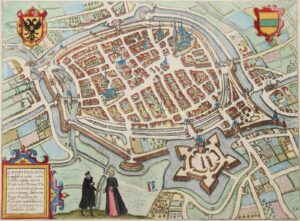


“Groninga”, copper engraving published in 1612 in Amsterdam by Willem Jansz. Blaeu, as part of Lodovico Guicciardini’s Beschrijvinghe van alle de Nederlanden anderssins ghenoemt Neder-Duytslandt. Coloured by a later hand. Size: 23.5 × 32 cm.
In the title cartouche at lower left, Groningen is described as a prosperous and populous city of Frisia, strongly fortified against enemy attacks. The cartographer Ptolemy (c. AD 87–150) of Alexandria is said to have called it Phileum. According to the (fictitious) chronicler Humbaldus, the city was founded as early as 377 BC by the legendary Grunno, the brother of King Anthenor of the Franks. Such references to classical and legendary origins were common in early modern urban literature, emphasizing the antiquity and prestige of the city.
The map itself shows Groningen in bird’s-eye perspective, encircled by canals and fortifications. At upper left is the city’s coat of arms with the double-headed eagle. The city is dominated by the Grote Markt with the town hall and the Martinikerk, and by the Vismarkt with the A-kerk. Both churches date back to the 13th century but were extensively altered and expanded in the 15th century. The Martinikerk is accompanied by the 97-meter-high Martinitoren, popularly known as “d’Olle Grieze” [the Old Grey One].
Thanks to its strategic location, Groningen grew into an important commercial hub in the 13th century. In 1282 the city joined the Hanseatic League, attracting many merchants. After a period of Habsburg rule (from 1536), Groningen was incorporated in 1594 into the Dutch Republic. Only a few years after the publication of this map, in 1614, the University of Groningen was founded.
Price: SOLD