

Water warfare 1793 – Johannes Pickee after Carel Frederik Bendorp



LINE OF DEFENCE ON THE HOLLANDS DIEP NEAR MOERDIJK: WATER WARFARE IN THE SPRING OF 1793
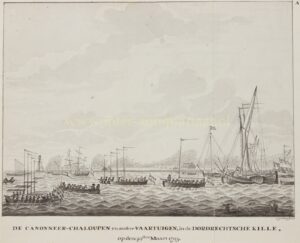
“De canonneer-chaloupen en andere Vaartuigen, in de Dordrechtsche Kille, op den 29sten maart 1793” [The gunner’s chaloupes and other vessels in the Dordrechtse Kil on 29 March 1793] and “De vloot gewapende pinken, voor den Moerdyk Strykende, op den 5den April 1793” [The fleet of armed pinks, passing before Moerdijk, on 5 April 1793.] Pen drawings made around 1795 by Johannes Pickee after engravings by Carel Frederik Bendorp. Size (sheet): each 20 × 25.3 cm.
In the early spring of 1793, as the French revolutionary armies advanced northwards from Brabant, the Dutch Republic suddenly found itself confronted with the vulnerability of its southern defensive line. The heavily fortified town of Willemstad, situated at the junction of the Hollands Diep, the Volkerak, and the approaches to the great rivers, became in those tense weeks the pivotal point in the defence of Holland. The struggle unfolded not only on land, but above all on the water—among sandbanks, kills, tidal currents, and shallow waterways.
While the French put pressure on the Brabant fortresses of Klundert and Steenbergen in February and March and carried out reconnaissance operations towards Moerdijk, hastily armed inland vessels were gathered from Dordrecht, Rotterdam, and Gorinchem. The Republic had no regular fleet available for these inland waters, so existing river and coastal craft were transformed into a light and highly manoeuvrable fighting force. The two drawings bear witness to this improvised flotilla, captured at the moment it assembled and manoeuvred in response to the threat of a French breakthrough.
The first snapshot appears in the depiction “The gunner’s chaloupes and other vessels in the Dordrechtse Kil, on 29 March 1793.” In the quiet tension before any decisive confrontation, we see the States Army chaloupes—long rowing vessels equipped with a single bow gun—moving through the narrow waterway between Dordrecht and the Hollands Diep. Rowers labour under command, officers confer, and supporting transport vessels lie among the chaloupes. Everything suggests that they are preparing to deploy rapidly should the French attempt to break through towards Holland via Moerdijk or the Hollands Diep. The Dordrechtse Kil thus served as a strategic gathering point from which Willemstad could be supported and any enemy crossing prevented.
Only a week later, the atmosphere has shifted. The second drawing, “The fleet of armed pinks, passing before Moerdijk, on 5 April 1793,” shows the State flotilla in motion—no longer merely waiting, but patrolling and visibly asserting its presence to deter the enemy. The pinks, small yet strongly built coastal sailing vessels, advance in a long line past Moerdijk, a place of strategic importance where the land narrows and a crossing into Holland was conceivable. The ships fly the States’ colours, their crews stand ready, and in the foreground a rowing boat filled with soldiers moves toward a larger vessel. This scene captures the dynamics of a day in wartime when the struggle was not decided by direct confrontation, but by holding positions, showing strength, and denying the French control over the waterways.
Meanwhile, Willemstad itself held firm. From 27 February to 15 March 1793, French forces had tried in vain to isolate the fortress and force its surrender. The defence—supported by inundations and by the continual possibility of resupply over water—broke the French pressure. When the French withdrew in early April, the region around the Hollands Diep remained tense, but the immediate danger appeared to have subsided. The images of 29 March and 5 April illustrate how the Republic, with improvisation and ingenuity, defended itself upon the water that had always been its natural ally.
Although the State flotilla successfully withstood French pressure in the spring of 1793 and Willemstad remained steadfast, this victory proved only a temporary turn in a much larger storm. Two years later the French armies returned, this time aided by a severe winter that rendered the water barriers ineffective and by political upheaval within the Republic itself. In January 1795 the old political order collapsed almost without a fight, the Stadholder fled to England, and the Batavian Republic was proclaimed.
Price: SOLD