

Amsterdam, flower market – Frederik Christiaan Bierweiler after Cornelis de Kruyff, c. 1824-1826
€2.450
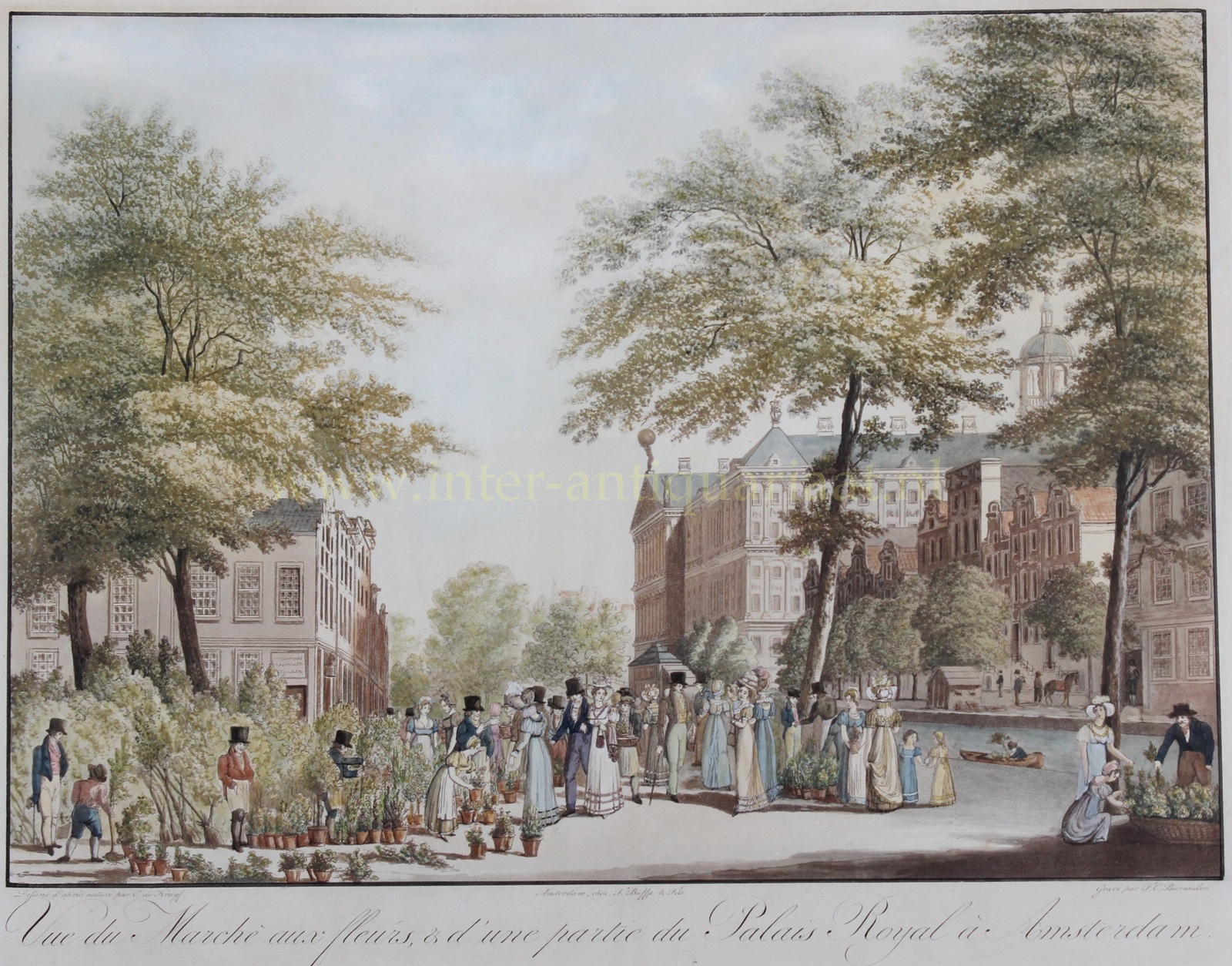


THE FLOWER MARKET ON THE NIEUWEZIJDS VOORBURGWAL, CA. 1825
“Vue du Marché aux fleurs, & d’une partie du Palais Royal à Amsterdam”, etching and aquatint made ca. 1824–1826 by Frederik Christiaan Bierweiler after a drawing by Cornelis de Kruyff, published in Amsterdam by Frans Buffa & Zonen. With original hand colouring. Size (image): 42 × 58 cm.
A lively view of Amsterdam’s flower market on the still open Nieuwezijds Voorburgwal, looking north. Along the quayside, traders have displayed their flowers, plants and young trees. Pots and baskets are arranged in rows on the ground, while vendors offer their wares to a colourful gathering of passers-by and customers. In the background rises the Royal Palace on Dam Square, the former town hall.
The flower market was held on the Sint-Luciënwal, a section of the Nieuwezijds Voorburgwal. As early as the seventeenth century, this was an important centre for the trade in flowers, plants, flower bulbs and trees. Much of the produce was brought in by water — as suggested by the small boat on the right — allowing growers and traders to bring their barges almost directly to the market. Flowers, bulbs, plants and seeds came from various horticultural districts in Holland, including the area around Haarlem and places such as Noordwijk and Rijnsburg. For young trees and shrubs, Amsterdam also relied on nurseries in Boskoop, Beverwijk and Alkmaar.
In 1862, the flower and tree markets left the Nieuwezijds Voorburgwal and moved to the Singel between Koningsplein and Muntplein. From this developed the present-day Amsterdam Flower Market. The Nieuwezijds Voorburgwal itself remained a canal for more than another twenty years; it was not filled in until 1884.
The appeal of the print lies not only in its topographical interest, but also in its detailed portrayal of everyday urban life. De Kruyff populated the market with flower sellers, children, servants and fashionably dressed townspeople, giving the scene almost the character of a genre painting. The elegant visitors in particular provide a fine picture of fashion in the 1820s. The women wear long, full dresses with waistlines that had by then descended again towards the natural waist, high-necked bodices and increasingly voluminous sleeves. Their hair is arranged in ringlets around the face and gathered into a bun, worn beneath a bonnet or poke bonnet. The fashionable male silhouette was almost feminine in its shaping: corsets and padding were used to create a narrow waist and broad chest. Hair was worn long, tousled or curled, while the tall stovepipe hat was the dominant form of headwear. The print is therefore a city view, a market scene as well as a snapshot of Amsterdam’s bourgeois society around 1825.
Frederik Christiaan Bierweiler (Amsterdam 1783 – after 1831) worked as an engraver in his native city and produced both etched and engraved prints. The nineteenth-century artists’ biographer Christiaan Kramm praised him as “a skilled artist who handled the mezzotint scraper with masterly skill.”
Provenance: sold by Simon Emmering on 21 October 1983 for Hfl. 5,500.
Price: Euro 2.450,- (incl. frame)