

Amsterdam, Dam square, Royal Palace – J.L. van Bever, ca. 1825
€1.450
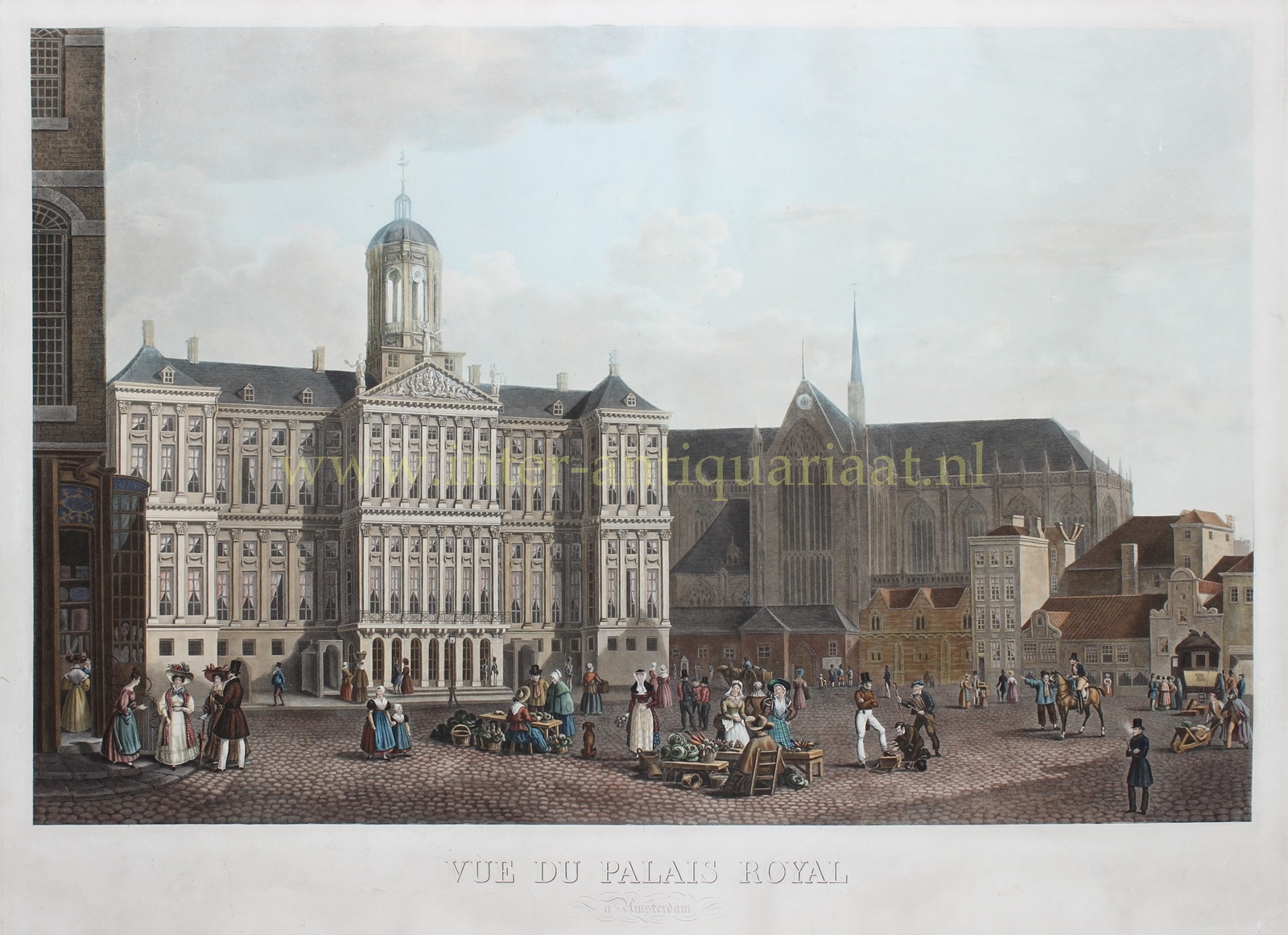
“Vue du Palais Royal à Amsterdam” [View of the Royal Palace in Amsterdam], etching and aquatint published by J. L. van Bever around 1825. Original hand colouring, with later additions. Size: 49.5 × 76.5 cm.
During the French period in the Netherlands, Louis Bonaparte decided to convert Amsterdam’s former Town Hall on Dam Square into a Royal Palace. Various alterations were made, including the addition of the balcony to the front of the palace. Because it obstructed his view, Louis also had the Waag, which stood in the middle of Dam Square, demolished.
The foreground is filled with lively street activity. Among the figures are vegetable sellers, a shoe-shiner, a walking-stick vendor, a departing mail coach and a porter. On the left, at the corner of the former Beurssteeg, a saleswoman from the Hoeden Magazijn or hat shop stands outside the premises greeting customers.
The print was made during the period of the United Kingdom of the Netherlands, between the French period and the Belgian Revolution. It may have been intended in part to reinforce the prestige of the new king, William I. As head of state he had a palace on Dam Square in Amsterdam and another in Brussels, where the government resided in alternate years. Both palaces were recorded in similarly impressive views.
These were lean years for Amsterdam. Little remained of the prosperity of the so-called Dutch Golden Age. Trade and shipping through the port of Amsterdam had declined sharply. The sea approaches had silted up, while wars with France and Britain and the Continental blockade of British goods further damaged commerce, leaving the once flourishing harbour greatly diminished.
Only after the opening in 1824 of the North Holland Canal, initiated by King William I, did shipping to and from Amsterdam begin to increase again, allowing the city gradually to recover.
Price: Euro 1.450,-