

Paramaribo – Gualtherus Mabé (attrib.), ca. 1816–1821


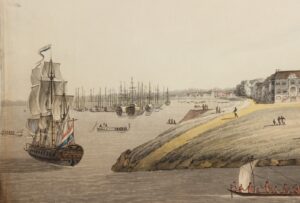


GRAND VIEW OF PARAMARIBO WITH FORT ZEELANDIA
Drawing with pen, washed ink and watercolour, attributed to Gualtherus Mabé, ca. 1816–1821. Size: 46 × 96.5 cm.
Following the conquest by a Zeelandic fleet under the command of Abraham Crijnssen in 1667, Suriname became a Dutch colony. The existing English fort on the Suriname River was renamed Fort Zeelandia. Around this fort, Paramaribo gradually developed into the administrative and commercial centre of the colony, favoured by its strategic position on the river.
From 1683, Suriname was governed by the Society of Suriname, a partnership between the West India Company, the city of Amsterdam, and the Van Aerssen van Sommelsdijck family. During this period, the plantation system took shape and came to define the colony’s economy. Along the Suriname, Commewijne, and Cottica rivers, sugar, coffee, cacao, and cotton plantations were established, entirely dependent on the labour of enslaved Africans. The colony’s prosperity was directly tied to the trans-Atlantic slave trade and the export of plantation produce to Europe. At the same time, Suriname remained a vulnerable and difficult-to-control colony, plagued by tropical disease, military tensions, and resistance from escaped enslaved people, the ancestors of today’s Maroons.
During the eighteenth century, Paramaribo grew into a prosperous colonial port city, with warehouses, merchants’ houses, military buildings, and landing stages along the Waterkant. The cityscape was dominated by timber construction, however, making fire a constant threat. Toward the end of the century, Suriname became entangled in the geopolitical upheaval of the Napoleonic era. With the Netherlands under French influence, the British occupied the colony briefly in 1799 and again from 1804. This English occupation lasted until 1816. Although the colonial administration changed hands, the plantation economy continued to function and Paramaribo remained an important trading hub in the Caribbean. These were also the years in which international criticism of the slave trade intensified; Great Britain officially abolished the trans-Atlantic slave trade in 1807.
After the fall of Napoleon, the Netherlands regained Suriname in 1816. New administrators, officials, and soldiers arrived to restore Dutch authority. The artillery officer Gualtherus Mabé (1793–1838) is in all likelihood to be placed in this same context. The drawing attributed to him shows Paramaribo during this transitional period: still unmistakably an eighteenth-century colonial settlement, yet with the early nineteenth-century Empire fashion already visible on the Gouvernementsplein (the open green in the foreground). To the right, Fort Zeelandia with its flagpole is recognisable, while to the left, along the Waterkant, a large number of ocean-going vessels lie at anchor — a reminder of the harbour’s central role in the colonial economy.
The scene appears to date from shortly after the departure of the English and before the great fire of January 1821, in which large parts of historic Paramaribo were lost.
Price: SOLD